Peck & Peck: Pursuing the “Useless”
A review of Bonnie Garmus’s Peck & Peck: a novel of poetry and impossible dreams
When Anne Carson won the Nobel Prize in Literature and made her way into the news and onto my Libby home page, I was intrigued. I’ve never considered myself a poetry person, but I do consider myself bookish, so I felt compelled to check out her work. She’s also Canadian, and these days, we in the Great White North are trying to read more Canadian. A few people on Reddit recommended The Glass Essay as a good starting point; their excitement made me excited.
So, I’m not sure how to say that I didn’t understand a single thing. Not understanding what I’m reading happens all the time, but I’ve learned to push through it. But I think what gives me that power is curiosity about what comes next, and The Glass Essay simply did not spark that curiosity in me.
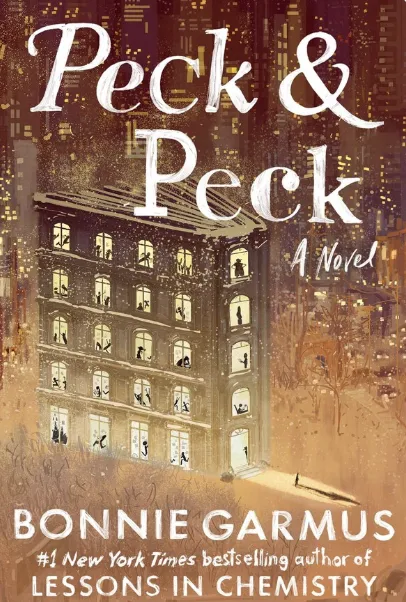
My failed poetry attempt did not affect my excitement for Bonnie Garmus’s fresh-out-of-the-oven novel, Peck & Peck. I still expected the poetry aspect to be my favorite part of this book, and it was. Because, you know, when there’s poetry and literature and music, when there is art, there is also passion. I love reading about people who are obsessed with something, even though they know that no money, prestige, or career will come out of the effort they are putting in. It’s so illogical, and yet that is who they are.
But there’s always the possibility that all that illogical effort may become something. Every aspect of the world is so interwoven that Langston Hughes’s Mother to Son may inspire Batter Grey’s pre-law essay about minimum wage because it gives him some kind of understanding, a meaning to something that would otherwise be full of statistics and citations and policies. Or Batter Grey could find himself working at Peck & Peck, a quarterly poetry magazine whose mission is to find the best of the best in the world. I’m having a hard time pinpointing what this story is about, and this is the closest I’ve come: it’s about the give and take between our passions and making a living, and becoming something in life.
In the book, Mr. Raley offers an answer to the definition of a calling: it is “just another word for common sense.” You choose something that makes sense for you, then, through practice and commitment, become “really good at—maybe great at—maybe even the best in the world at.”
If you’re thinking this book is ruminating, depressive, and full of tortured poets, yeah, there is that. But it’s super witty, fun, and absurd (Peck & Peck has 39 editors; this is the level of absurdity), so the overall tone is just a good time. It gets nerdy here and there with things like Nayi Kavita, New Formalism, the Native American poetry renaissance, or the nitty-gritty of typefaces, but please, trust me: they will only make you love this book more.
PS: Nothing in this blog post is meant to suggest that Anne Carson did not deserve her prize. Of course she did. First, I don’t dare say otherwise; second, my experience was more like: I know I am reading something beautiful. I appreciate the beauty of what is in front of me, but goddamn it, I don’t get it.